

















News from Coop Bénimellal-KHénifra
AfDB: Morocco on a solid economic growth trajectory to 2027


This favorable dynamic is based on several drivers identified by the AfDB: increased agricultural production, made possible by more favorable rainfall and a government program to rebuild livestock after years of drought-related losses, increased tourism revenue, sustained public investment in modernizing transport systems, and increased manufacturing productivity, driven by phosphate production and higher value-added exports from the automotive and aerospace sectors.
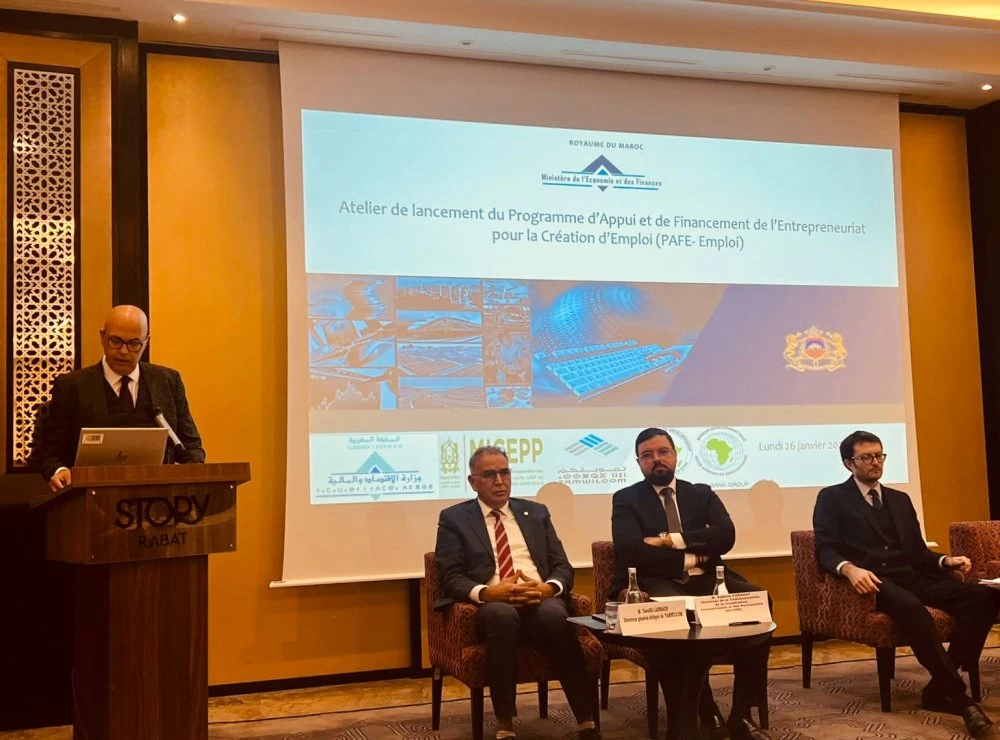
On the monetary front, the Report notes that the Central Bank of Morocco kept its key interest rate stable after several successive cuts, a sign of controlled inflation. The country also has projected inflation of 1.91% on average over 2026-2027, among the lowest on the continent, and an expected budget deficit of 3.11%. GDP over the same period. The current account balance is expected to reach -2.51% of GDP, reflecting a generally contained external position. Regarding foreign exchange, the Bank notes that the strength of Morocco's foreign exchange reserves has helped to mitigate external pressures and support financial stability. However, these forecasts should be interpreted with caution. The AfDB report does not appear to incorporate developments related to the conflict that erupted in Middle East in February. However, this new geopolitical situation could lead to an increase in energy prices, increase transport costs and revive the inflationary pressures, with potential implications for macroeconomic balances and financial conditions.
North Africa in clear recovery
At the regional level, the’North Africa is on a trajectory of pronounced recovery. The AfDB estimates the region's growth at 4.11 TFPs in 2025, compared to only 2.71 TFPs in 2024, and projects a continued acceleration to 4.21 TFPs in 2026, then 4.41 TFPs in 2027.
This regional recovery is driven by several economies. The Libya displays the most spectacular performance, with growth estimated at 12.41 TFPs in 2025 thanks to the strong rebound in its oil production – close to 1.3 million barrels per day compared to 1.1 million in 2024 – before slowing to 5.21 TFPs in 2026.’Egypt, Meanwhile, it is recording growth estimated at 4.11 TFPs in 2025, expected to reach 4.41 TFPs in 2026, driven by strong foreign direct investment (FDI) in port infrastructure, the creation of industrial zones, and manufacturing expansion. Mauritania should see a recovery from 41.3 TFPs in 2025 to 5.21 TFPs in 2026, thanks to the expansion of its liquefied natural gas and iron ore production.’Algeria progresses more modestly, from 3.31 TEUs in 2025 to a projected 3.91 TEUs in 2026. The Tunisia, Finally, it shows more modest growth, estimated at 2.5% in 2025 and expected at 2.8% in 2026, thanks to the gradual easing of inflation, the recovery of tourism and the improvement of agricultural performance.
The region also benefits from a growing geostrategic position in the context of fragmented globalization. North Africa attracted $52.1 billion in FDI in 2024, more than half of the continent's total, notably through renewable energy projects in Tunisia and Morocco, and the massive Ras El-Hekma development project in Egypt (a $35 billion partnership). FDI flows increased by 21.21% to $936 million in Tunisia and by 55.41% to $1.6 billion in Morocco.
A resilient continent, but persistent disparities between regions
At the continental level, the AfDB estimates African growth at 4.21 TPP in 2025, up 0.7 points compared to 2024, and projects a stabilization at 4.31 TPP in 2026 and then an acceleration to 4.51 TPP in 2027. Africa should thus remain among the fastest growing regions of the world, home to 12 of the 20 most dynamic economies on the globe in 2025.
However, significant regional disparities remain. East Africa remains the most dynamic region, with growth estimated at 6.41 TEUs in 2025 – driven in particular by Ethiopia (9.81 TEUs), Rwanda (7.51 TEUs) and Uganda (6.41 TEUs) – a pace maintained in 2026 before a slight slowdown to 6.31 TEUs in 2027. West Africa shows growth estimated at 4.71 TEUs in 2025, driven by Senegal (8.11 TEUs), Niger (7.81 TEUs), Guinea (7.21 TEUs), Benin (7.11 TEUs) and Côte d'Ivoire (6.41 TEUs), before a slight moderation to 4.61 TEUs in 2026 and a rebound to 4.81 TEUs in 2027. Central Africa is experiencing a slight slowdown in 3.91 TFPs in 2025, but is expected to recover to 4.21 TFPs in 2026 and 4.31 TFPs in 2027, driven by the Democratic Republic of Congo and its mining investments. Southern Africa remains the continent's weakest performing region, with growth estimated at only 21 TFPs in 2025, hampered by structural constraints in South Africa (11 TFPs) and the contraction in Botswana (-0.81 TFPs). The region is nevertheless expected to gradually improve to 2.41 TFPs in 2026 and 2.61 TFPs in 2027.
The AfDB emphasizes that while the African macroeconomic outlook is strengthening, substantial risks remain: over-indebtedness, geopolitical instability, climate shocks, and reduced official development assistance flows. The institution calls for bold structural reforms, increased mobilization of domestic resources, and deeper regional integration within the framework of the African Continental Free Trade Area to sustainably consolidate this growth momentum.
