






















News from Coop Bénimellal-KHénifra
From Rabat to San Francisco: Youssef Denial, architect of places and meanings (Portrait)


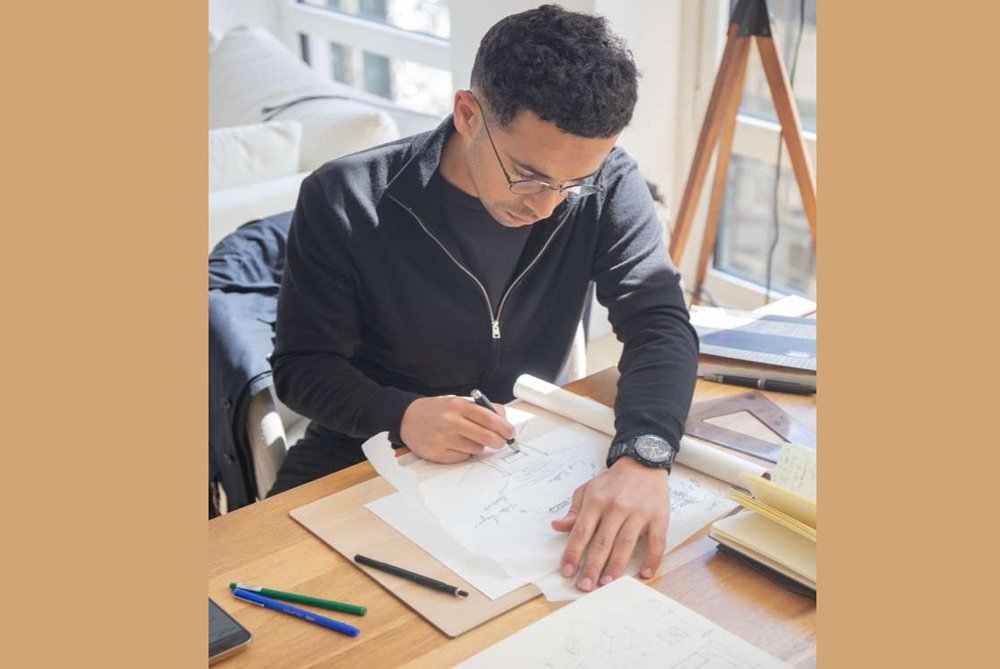
The look before the line
What immediately strikes you about Youssef Denial is the primacy of observation over gesture. Where other architects start with drawing, he begins with observation. The patterns of experience, the invisible logics that connect one room to another, a building to its neighborhood: it is this hidden grammar of space that has nourished his vocation. "I have always been curious about what my eyes could not immediately see in a space. The patterns of experience, the fundamental orders, and the changes in interaction from one room to another."«
This curiosity gradually transformed into conviction: architecture doesn't create isolated objects; it reveals the latent qualities of a site. Before drawing, one must know how to read a landscape, to decipher the interactions between the city, the territory, and its inhabitants. "I realized that architecture begins with the experience of place. Before drawing or building anything, there is first a process of observing and understanding how landscapes, cities, and people interact."
From Rabat to Yale, the requirement of a dual anchoring
Youssef Denial's career path testifies to a quest for excellence pursued without severing ties with his roots. Originally from Morocco, he earned his Bachelor's degree in architectural design, with honors, from the University of Washington, before pursuing a Master of Architecture at Yale University, one of the most selective architecture schools in the world. Even at Yale, his work asserted a strong identity. Selected to represent the university at the Venice Biennale, within the Estudio A0 program (Surfacing: The Civilized Agroecological Forests of Amazonia), he explored the relationship between architecture, landscape, and ecological systems—a foundational theme he has never abandoned.
Hart Howerton, the field of the large scale
Currently based in San Francisco, Youssef Denial works at Hart Howerton, an internationally renowned architecture and planning firm known for its large-scale projects in North America, Latin America, Europe, and Asia. In this multidisciplinary environment, he works on urban planning, residential, hospitality, and mixed-use development projects throughout the United States and Latin America.
The scale of these projects necessitates a collaborative working method where the architect is in constant dialogue with engineers, urban planners, and local communities. Far from the solitary act of the architect, Youssef embraces this collective dimension. "As the projects grow in scale, architecture increasingly becomes a conversation. Ideas emerge through collaboration between engineers, designers, planners, and communities."
An international track record that speaks for itself
The rigor of this approach has earned Youssef Denial a series of international accolades. He is a recipient of three Silver Awards – at the London Design Awards (Institutional Architecture), the Muse Design Awards (Healthcare Architecture), and the New York Architectural Design Awards (Cultural and Community Centers). His conceptual project Physical & Ephemeral Waste has received several Architecture MasterPrize awards in the categories of conceptual architecture, cultural architecture, and infrastructure. In addition, there is a third Prizes at the Design Unlimited Awards for a proposal for a renewable energy research center, as well as an honorable mention in the Young Architects Competition (YAC) for the Volcano Horsemen Retreat project.
Bath, the Moroccan mosaic as a spatial matrix
However, it is his most recent project that best illustrates Youssef Denial's synthesis of cultural heritage and architectural innovation. Spirituality & Education: Re-Creation, winner of a Silver Award at the French Design Awards, is located in Bath, England, a city historically linked to Roman aqueducts and thermal baths. The project proposes a hybrid center—cultural, educational, and dedicated to well-being—that challenges the conventional separation between learning and spiritual spaces. Learning, meditation, and physical practice are organized around a single concept: Re-Creation, understood as the renewal of knowledge and the reconnection of the individual with themselves through ritual and embodied experience. «Programmatically, the project challenges the traditional separation between educational and spiritual spaces by bringing them together.» Learning, meditation, and physical practice are organized under a single concept of Re-Creation, referring both to renewed learning and the restorative process of reconnecting with oneself.
But the project's originality also lies in its architectural grammar. Youssef transposes the geometric patterns of Moroccan mosaics, not as a decorative element, but as a structuring principle that organizes the circulation and spatiality of the entire building. "Architecturally, the project draws inspiration from the geometric patterns of Moroccan mosaics. Rather than serving as decoration, these patterns organize the circulation and spatial structure of the building, linking classrooms, bathrooms, meditation rooms, workshops, and recreational spaces in a continuous spatial rhythm," he explains. The result is a holistic architectural environment where geometry, intelligent materials, and spatial design redefine the relationship between learning, ritual, and the experience of space.
Building begins with listening.
Looking to the future, Youssef Denial pursues a body of work focused on residential, hospitality, and urban planning projects that strengthen the connection between people and their environments. In a profession increasingly shaped by global collaboration and the ecological emergency, he embodies an approach that reconnects sustainable architecture with the cultural and ecological realities of places. His philosophy can be summed up in a single phrase, which he expresses with the same simplicity as his early drawings: «Architecture is not just about building objects. It’s about initiating a dialogue with a place; understanding its history, its landscape, and the people who inhabit it.» From Rabat to San Francisco, from the Venice Biennale to the snow-capped peaks of Utah, Youssef Denial cultivates this patient, demanding dialogue, remaining true to the land of his birth.
