





News from Coop Bénimellal-KHénifra
Learning about Equatorial Guinea for Kids – Lesson Plans


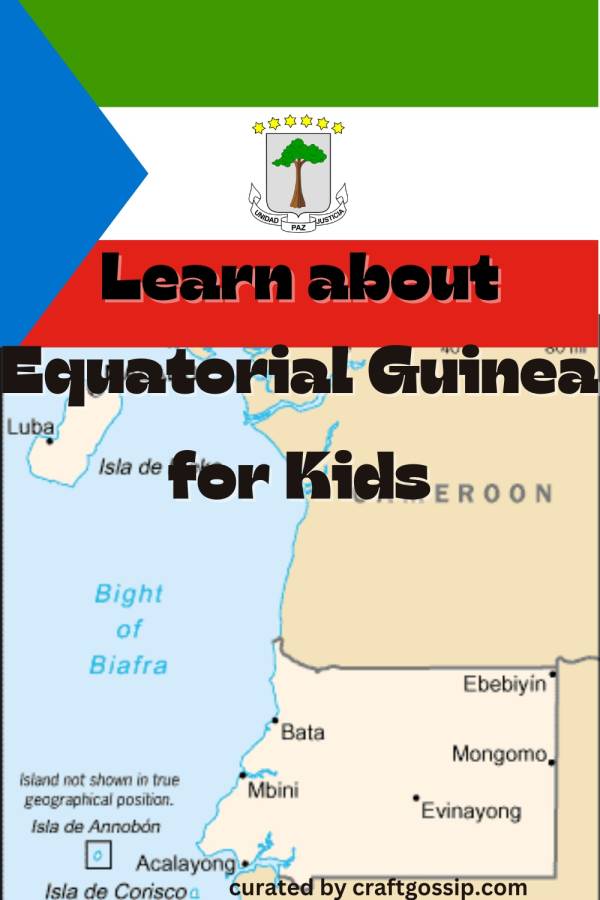
Equatorial Guinea is a country in central Africa that's officially known as the Republic of Equatorial Guinea. It includes a portion of mainland Africa, known as Rio Muni, which is bordered by Cameroon and Gabon, and also includes several islands.
Equatorial Guinea Basics
- Capital: Ciudad de la Paz (formerly Malabo, the change was made in 2026, more on that below)
- Largest city: Bata
- Area: 10,830 square miles, or 20,050 square kilometers
- Population: almost 1.8 million
- Official languages: Spanish, French and Portuguese, but many regional languages are also recognized; it's the only Spanish-speaking nation in Africa
- Demographics: 85 percent of people from Equatorial Guinea (the word to use is Equatoguinean, or Equatorial Guinean) are Fang, a Bantu ethnic group; 88 percent are Christian
- Government: Equatorial Guinea has a president but the country is an authoritarian dictatorship
- Name: the name notes that the nation lies on the equator and is part of the region of Guinea, and also was formerly named Spanish Guinea
- History: The area of Equatorial Guinea was first settled by Pygmies; it was first explored by the Portuguese in 1472 and ceded to Spain in 1778. It gained independence in 1968 and the president declared himself president for life in 1972. He was overthrown by his nephew in a coup in 1979 and the nephew has been in power ever since.
- Money: Central African CFA Franc
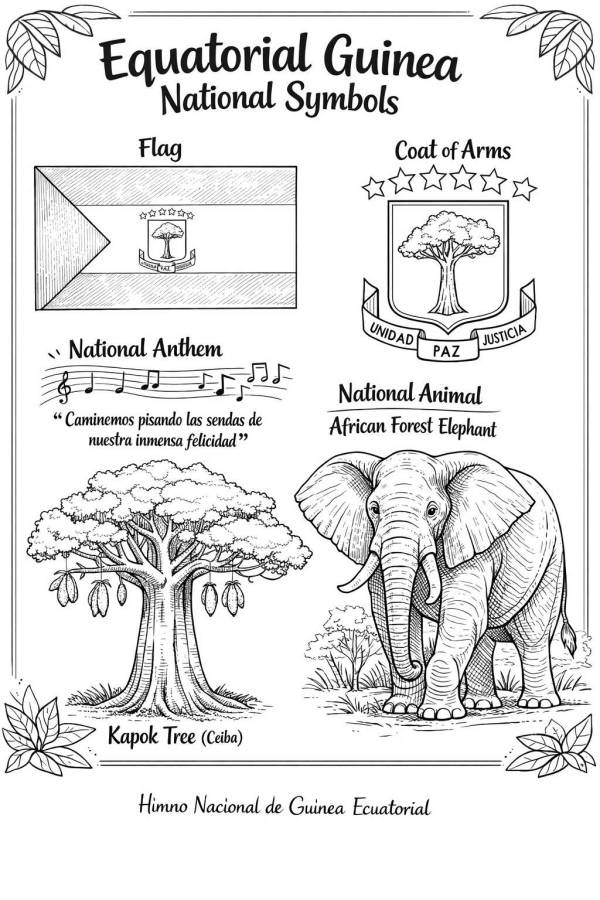
Equatorial Guinea National Symbols
- Flag: The flag consists of a green, white and red stripe with a blue triangle on the left side and the coat of arms is in the center of the white stripe. The flag was adopted in 1968 but was altered during Francisco Nguema's rule. The original flag was reinstated in 1979. Green represents natural resources, white is for peace, red for the blood shed in the independence fight and green for the sea linking the mainland and its islands.
- Coat of arms: The coat of arms features a gray shield with a silk cotton tree in the center. There are six yellow five-pointed stars above the shield, which represent the mainland and the islands. Below the shield is a ribbon that says the motto in Spanish: Unity, Peace, Justice.
- National anthem: “Himno Nacional de Guinea Ecuatorial,” also known by the first line, “Caminemos pisando las sendas de nuestra inmensa felicidad” (let us walk treading the paths of our immense happiness) was first performed on the nation's independence day in 1968.
- National tree: Ceiba pentandra, which has many names but is commonly called kapok in English, is the national tree and is featured in the coat of arms. The tree is known as silk cotton because of the cottony fluff that comes from its seed pods.
- National animal: I don't have official confirmation but some sources say the national animal is the African forest elephant, which ranges through the rainforests of central Africa.
Learning About Equatorial Guinea
So why did they move the capital? This would be a fun research project for older kids, but the short answer (thanks, Wikipedia!) is that Ciudad de la Paz (City of Peace) is a planned city located near the center of the mainland part of the country. Its location was chosen for its proximity to Bata and Mongomo, as well as an airport.
It has a milder climate than the old capital and was developed in part because of easy maritime access to the old capital, which worried people after a 2004 coup attempt. Ciudad de la Paz became the capital of Equatorial Guinea on Jan. 2, 2026.
Check out some cool places in Equatorial Guinea via Taytrum Travels.
Find more facts about Equatorial Guinea at Spanish Academy, and more about teaching about the country for Spanish speakers at Srta Spanish (be sure to check out the video about how an Equatorial Guinean speaks Spanish and some of their slang words).
Classy has a printable Equatorial Guinea lapbook, and you can find lots more paid resources for learning about the country at Teachers Pay Teachers.
The Flavor Vortex has a good post about Equatorial Guinea food, which talks about pickapeppa soup, succotash and paella. National Dish claims succotash is the national dish of Equatorial Guinea (even though their recipe adds bacon and admits that's inauthentic). Good Food on Bad Plates has another recipe.